
When Saying No Feels Terrifying: The Hidden Cost of Being the Family Savior
What it feels like to finally trust yourself — and what becomes possible when you stop abandoning yourself to keep everyone else comfortable
Most women know what it feels like to say yes when they mean no.
The tug at their heart.
The tightening in their chest.
The throbbing in their head.
Avoiding what they really feel.
Talking themselves out of what they already know.
And underneath all of that…
The resentment that quietly builds.
The exhaustion of managing everyone else’s needs while their own needs go unmet.
Again.
Why Saying No Feels So Hard
Much of this comes from the parts of us that learned it was safer to stay quiet, over-give, or keep the peace.
Safer than risking conflict, disappointment, or rejection. Safer than telling the truth and feeling someone else’s hurt, anger, or withdrawal.
Many are still trying to navigate adult relationships with the emotional patterns of a hurt inner child who never fully learned it was safe to say:
“No.”
“I need something too.”
“This doesn’t work for me.”
“I matter.”
So instead…
They override themselves. Not because they are broken or weak. Because saying yes became connected to love, safety, and belonging. And saying no felt terrifying.
I know this place intimately.
I also know what begins happening when a woman learns to stay with herself instead of abandoning herself when discomfort appears.
Little by little, she begins to feel safer inside herself.
The moment after the no has been spoken. The moment she realizes:
“The relationship didn’t end.”
“I survived telling the truth.”
And instead of guilt or panic, something unexpected begins to appear.
Space. Peace. Self-trust.
A calm center that no amount of effort could have forced into place.
That is what it means to finally trust yourself. Not a strategy or something you perform.
A way of being that emerges when you stop giving your life away and start expressing your true self.
I have watched this transformation unfold in the lives of many women I work with.
The Pattern Has a Reason
One woman in particular comes to mind as I write this.
She had spent years being the one her family turned to when things fell apart. She was steady, capable, and always found a way.
She was good at it. And it was costing her more than she realized.
There was no single breaking point. Just a slow, steady drain — the kind that is easy to miss because, from the outside, it looks like strength.
Over time, she began seeing herself more clearly.
Every time someone came to her in crisis, her body reacted before she even had time to think. Tightening. Bracing. Getting ready to fix it.
And underneath that response was something deeper:
If she stopped stepping in…
If she disappointed someone…
If she stopped being the one who held everything together…
Who would she be then?
She was beginning to understand why saying no felt so hard for her.
Instead of attacking herself for it, she started getting curious about what was really underneath it.
Why it existed.
What she had been afraid would happen if she stopped.
What it was costing her.
And what she was receiving from staying inside it.
Because every pattern has both costs and payoffs.
When she carried everyone else, she felt needed. Important. Like she mattered.
And if she stopped, part of her feared she would lose love, safety, belonging.
Once she could lovingly see her motivations clearly, something softened. She began to see — without self-blame — what the role of family savior had cost her.
Her energy.
Her peace.
Her connection to her needs, desires, and limits.
These had been quietly left behind every time someone else’s crisis arrived at the door. And slowly, she began moving through forgiveness.
Forgiving herself for believing she had to earn love.
Forgiving herself for the years she ignored her own needs, overrode her truth, and said yes when every part of her wanted to say no.
Forgiving the people who taught her — directly or indirectly — that her worth was connected to what she did for others, how well she behaved, and whether everyone around her was okay.
And even allowing space for the people around her to adjust to who she was becoming.
Because she was changing. No longer rescuing. No longer over-functioning. No longer abandoning herself to keep everyone else comfortable.
She chose forgiveness because she no longer wanted her past to be deciding how she lived, loved, and related in the present. She released the belief that it was her job to hold everything together. And in its place, something steadier arrived.
What Trusting Yourself Actually Feels Like
The day came when her sibling brought another crisis to her door. And she said no.
Not with anger.
Not with a rehearsed speech.
Not bracing for the guilt she had always felt before.
Just a clear, steady no.
Afterward, she expected to feel guilty. Instead, she felt something lift. A weight she had been carrying so long she had stopped noticing it was there.
What replaced it was not emptiness. It was peace. Not because the situation had been resolved. Because she had not abandoned herself inside it.
That is what trusting yourself feels like from the inside.
Not loud or dramatic. A clear, steady no that does not wobble.
The simple, settled knowing that you are the caretaker of your own life — and no longer responsible for carrying other people’s emotional world.
What Changes Around You
And something else began changing too. Her relationships became lighter. More honest and balanced.
Family members stopped bringing every crisis to her door.
Other people began carrying responsibilities she used to automatically take on herself.
She could actually enjoy being with the people she loved instead of constantly managing, fixing, or rescuing. There was more joy. More play. More receiving.
She stopped collapsing on the couch depleted from carrying everyone else. She started listening to herself more naturally.
Resting when she was tired.
Saying no when she meant no.
Taking care of herself without guilt.
And for perhaps the first time in her life, she allowed herself to be supported too.
That is the real shift.
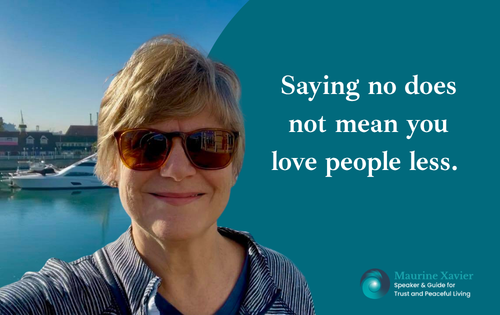
Not becoming hard. Not loving people less. Finally loving herself enough to stop leaving herself behind. And from that place, she could finally feel relaxed and free around the people she loved.
If something inside you knows it is time for a different way of living, loving, and relating…
I would love to connect with you.
With love,
Maurine